
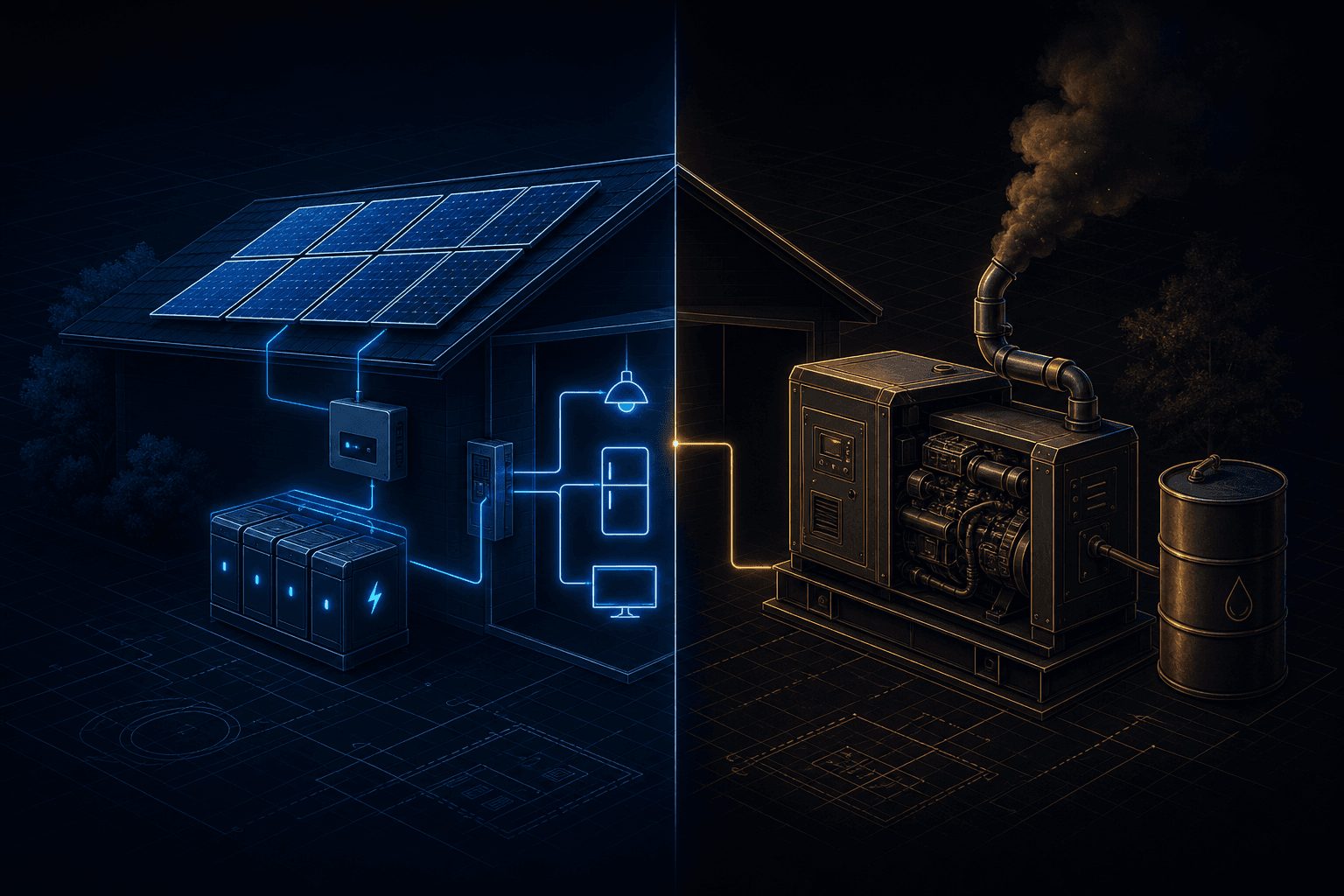
When the grid fails in Accra, Tema, or Kumasi, the question is rarely whether you need backup — it is which backup. Diesel generators are familiar, fast to rent, and loud. Solar-plus-battery systems are quieter, cleaner, and more expensive up front. The right answer depends on your load, how long you need autonomy, and how you value fuel, noise, and maintenance over three to seven years.
This guide walks through the design choices and the calculations REST Automation uses in early scoping. It is not a substitute for a site survey — it is the decision framework we use before we size hardware.
The five design choices that matter
- Load profile — which circuits must stay on, and at what continuous and surge watts.
- Autonomy — how many hours (or days) of outage you need to cover without fuel top-ups.
- Runtime pattern — short evening outages versus multi-day industrial downtime.
- Noise, emissions, and space — generator setbacks, exhaust, and neighbour constraints.
- Cash vs lifecycle cost — capital today versus fuel and service over the system life.
Step 1 — Size the daily load
Start with a critical-load list. For each appliance, multiply watts × hours per day × quantity, then sum to get daily energy in kilowatt-hours (kWh).
| Load | Watts | Hours / day | Qty | kWh / day |
|---|---|---|---|---|
| LED lighting | 120 | 6 | 1 | 0.72 |
| Fridge / freezer | 180 | 10 | 1 | 1.80 |
| Fans | 75 | 8 | 3 | 1.80 |
| Wi-Fi + TV | 150 | 5 | 1 | 0.75 |
| Phone / laptop charging | 100 | 4 | 1 | 0.40 |
| Total | — | — | — | 5.47 |
Add a 20–30% contingency for unknown loads and inverter losses. In this example, plan around ~7 kWh/day of usable battery energy for a full night of backup.
Step 2 — Diesel fuel and runtime cost
A small residential generator (5–8 kVA) might burn roughly 1.0–1.8 litres per hour at typical household load. At Ghana diesel prices, that becomes a recurring cash cost every outage night — plus oil changes, filters, and eventual rebuilds.
| Assumption | Value |
|---|---|
| Fuel burn at load | 1.4 L / hour |
| Diesel price (illustrative) | GHS 15 / L |
| Cost per hour | GHS 21 |
| Outage hours / month | 40 hours |
| Monthly fuel only | GHS 840 |
| Annual fuel only | GHS 10,080 |
Over five years, fuel alone can exceed GHS 50,000 before maintenance — often more than the premium of a well-sized solar-plus-battery package for the same critical loads. Your numbers will differ; the method does not.
Step 3 — Solar and battery sizing
For solar backup, battery capacity must cover the autonomy window. Panels must recharge that battery on a typical Accra sun day (peak sun hours ≈ 4.5–5.5 depending on roof and season).
- Battery usable kWh ≈ daily critical load × days of autonomy ÷ depth-of-discharge factor.
- Inverter kVA ≥ continuous critical watts ÷ 0.8, with headroom for motor surge.
- PV kWp ≈ (daily kWh ÷ peak sun hours) × system loss factor (often 1.2–1.4).
Step 4 — Lifecycle comparison
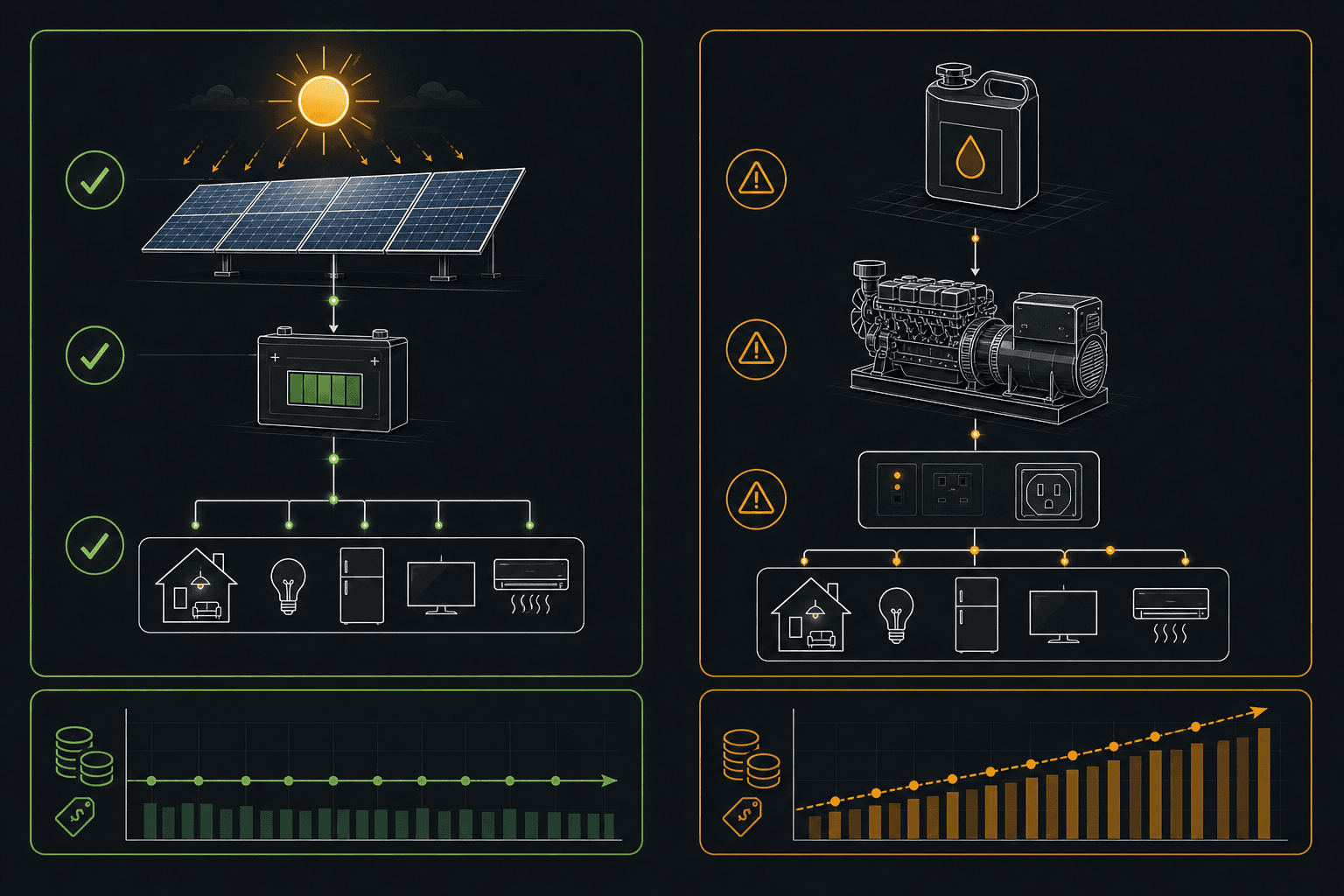
Compare capital, fuel, service, and soft costs (noise complaints, fuel logistics, downtime when the set fails to start). The table below is a planning illustration for a home critical-load scenario — not a quote.
| Cost line | Diesel generator | Solar + battery |
|---|---|---|
| Upfront hardware + install | Lower | Higher |
| Fuel over 5 years | High and volatile | Near zero for backup use |
| Routine service | Frequent (oil, filters) | Lower (inspections, firmware) |
| Noise / emissions | High | Silent at night |
| Grid-tied daytime value | None | Offsets daytime bills |
| Typical 5-year TCO trend | Fuel-dominated | Capex-dominated, then flat |
Decision summary
- Map critical watts and daily kWh first — never size from generator kVA alone.
- Price diesel on hours × litres × fuel, not on purchase price.
- Size solar on autonomy and recharge, not on panel count marketing.
- Revisit the choice when loads grow (AC, pumps, workshops) — hybrids are common.
Let REST Automation help you decide
Bring your load list or a rough floor plan. We model solar, diesel, and hybrid options with Ghana-aware sun hours and pricing assumptions — then you choose with numbers, not guesswork.